How paper shooting targets are scored: the ISSF gauge rule
Electronic targets measure decimals. Paper works differently—and knowing the actual gauge rule changes how you read your cards.
Published · Updated · Written and source-reviewed by the TargetIQ editorial team
Full-ring paper scores are integers
A person reading a physical target records the whole-number value of the scoring zone: 1 at the outside through 10 at the centre. Decimal values such as 10.4 and 9.8 can be assigned by an ISSF-approved electronic scoring system, but they are not obtained by estimating a decimal from a torn paper hole.
The official paper-scoring annex says doubtful holes are decided with compliant gauges or overlays. This guide explains the geometry so a shooter can understand the result; it does not replace jury procedure.
10 m Air Rifle ring dimensions
The 10 m Air Rifle target is unusually fine. Its central 10 dot is 0.5 mm across—smaller than the 4.5 mm pellet—and the diameter grows by 5 mm from one scoring zone to the next.
| Ring | Zone diameter | Ring-line radius |
|---|---|---|
| 10 | 0.5 mm (central dot) | 0.25 mm |
| 9 | 5.5 mm | 2.75 mm |
| 8 | 10.5 mm | 5.25 mm |
| 7 | 15.5 mm | 7.75 mm |
| 6 | 20.5 mm | 10.25 mm |
| 5 | 25.5 mm | 12.75 mm |
| 4 | 30.5 mm | 15.25 mm |
| 3 | 35.5 mm | 17.75 mm |
| 2 | 40.5 mm | 20.25 mm |
| 1 | 45.5 mm | 22.75 mm |
Current dimensions: ISSF General Technical Rule 6.3.4.3. The black aiming mark covers scoring zones 4 through 9; the 10 is a white dot.
The gauge rule: touching counts
Rule 5.2.1 of the paper-scoring annex gives the central test: if the shot hole or a plug gauge inserted into it touches any part of the outside edge of a higher-value ring, the shot receives the higher value. A pellet centre may therefore sit in the 8 zone while the edge of the hole reaches the 9 ring.
For a clean, circular 4.5 mm hole, the equivalent geometry is useful: a shot reaches a ring when its centre is no farther from the target centre than that ring's radius plus 2.25 mm. Real holes tear and printed rings have tolerances, so official doubtful calls still use the prescribed gauge or transparent overlay.
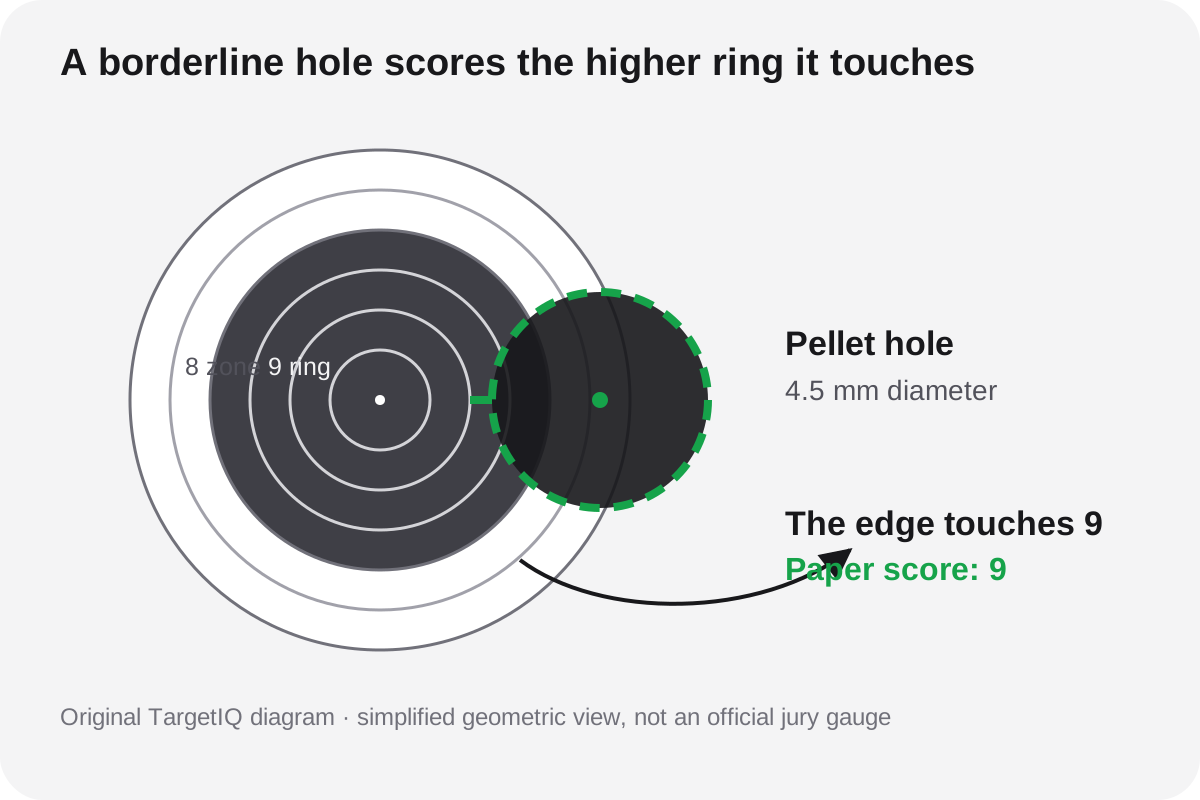
Three idealised borderline examples
The 9-ring radius is 2.75 mm. Adding the 2.25 mm pellet radius puts the ideal higher-value threshold at 5.00 mm from the target centre.
| Shot-centre distance | Ideal edge | Full-ring result |
|---|---|---|
| 4.99 mm | Reaches inside the 9 boundary | 9 |
| 5.00 mm | Meets the 9 boundary exactly | 9 |
| 5.01 mm | Misses the 9 boundary | 8 |
These are mathematical examples using perfect circles. Do not use a phone measurement at hundredth-millimetre precision to decide an official protest.
Why inward and outward gauges exist
A 4.5 mm inward gauge compares its measuring edge directly with the relevant higher-value ring and is specified for the outer Air Rifle rings 1 and 2. The inner Rifle rings 3 through 10 use a 5.5 mm outward gauge. Its larger flange is compared with a lower reference ring, which makes a doubtful call readable even when the pellet hole is wider than the tiny central rings.
Both methods implement the same scoring-zone boundary, but the official annex specifies which physical tool and reference ring must be used. A gauge is inserted only once into a disputed hole and by an authorised jury member in official procedure.
Air Rifle inner tens (X)
An Air Rifle inner ten is not simply any 10. The 0.5 mm central dot must be completely shot out. The official check uses an Air Pistol outward gauge: if its measuring edge does not extend outside the Air Rifle 7 ring, the shot is an inner ten. In ideal geometry, the shot centre is within 2.0 mm of target centre.
Air Pistol has a different inner-ten gauge and reference ring. Do not carry the Rifle 2.0 mm shortcut across events.
Paper-scoring glossary
- Scoring zone
- The area assigned one full-ring value, bounded by printed scoring rings.
- Doubtful shot
- A hole close enough to a ring that its value cannot be decided confidently without a gauge or overlay.
- Inward gauge
- A plug gauge whose measuring edge is compared directly with a higher-value ring for the specified outer rings.
- Outward gauge
- A larger flange compared with a lower reference ring for the specified inner rings.
- Inner ten (X)
- A ten meeting the event-specific inner-ten test and counted separately for ties or analysis.
Club prints and imperfect cards
Practice targets are not always regulation prints. Scaling a PDF, printer margins, paper movement and ring-line thickness can all change the card. For training analysis, measure the geometry actually printed rather than assuming every club card is exact. For an official competition, use approved targets and the governing rules.
Official references
- Current ISSF Rule Book and rules index: General Technical Rule 6.3.4.3 contains the 10 m Air Rifle target dimensions.
- ISSF Rules for Paper Target Scoring: sections 1.4 and 5.2 describe gauges, disputed holes and the higher-ring-touch rule.
Source check completed 6 August 2026. Always consult the current official publications for a competition decision.
TargetIQ applies event-specific paper geometry to a photograph, then shows every proposed ring and shot marker for correction before the score enters your training history.
Start scoring free →